Wednesday, April 27, 2011

Spirit Production

A man and his forklift. Willbur's favorite activity: Moving stuff, in this case a 3000 pound tote of Blackstrap Molasses. The molasses arrived from New Orleans. The guy who delivered it got blocked in by a school bus and spent two hours looking over our shoulder and trying to convince us to participate in an underground moonshine ring. Truckers are phenomenally entertaining and consistently the most interesting people we deal with.


40 gallons of molasses and 600 liters of filtered water are the base of our rum "wash." Watching the molasses flow into the "mash tank" is deeply relaxing. Cleaning the tank at the end of the day is not. Actually its torture. It usually involves one of us climbing into the tank and scrubbing it by hand. Not fun for two lanky guys.


The hydrometer, which measures alcohol by volume, reads 85, which means the spirit is coming off the still at 170 proof. On the left is wheat whiskey. Yes, whiskey is clear when it exits the still. It's the barrels that give whiskey it's distinctive hue. At 170 proof, I don't recommend putting this in a mint julep. We'll cut it down to 60ABV (120 proof) with filtered water. It then heads into the barrels to mature. Once it's done mellowing, we'll cut it down to 40ABV (80 proof). Mint Julep time.


The vapor flows through the condenser and then out the spout pictured on the left. We collect it in gallon jugs and separate out the "hearts," which is the middle portion of the run. The gallon jugs allow us to separate the best spirit with precision. We'll combine a small portion of the "heads" (front portion of the run) and "tails" (back portion of the run) for complexity and flavor. The still fills a gallon jug every fifteen minutes (roughly).

Friday, April 22, 2011

Men at Work

On the left is the beginning of a 1,200 liter, wheat mash. The wheat is mixed with filtered water and enzymes are introduced to break down the starch. Once the starch has been converted to sugar, yeast is added to convert the sugar to alcohol. The mixture is pumped into a fermenter and sits for five days, at which point it is 11% alcohol by volume (scroll down).


Here's a picture of Will mixing in 16 bags of wheat, which weigh 50 pounds each. The wheat is shipped from Aurora Mills Farm in Linneus Maine, a small town on the border of Canada. On average, we go through 1,600 pounds of wheat a week (Scroll down).


Once the mash is finished fermenting, we pump it into the still (more on that in an upcoming post). Once the cuts have been made, and the best spirit has been separated, we blend it down to 40 alcohol by volume with filtered water. In the case of our vodka, it is then chilled to 30F and carbon filtered, after which it is filtered again using a particle filter (scroll down).


The production board. Keeping track of what mash finishes when gets confusing (I know. Sad). We take down the date of each mash, the BRIX (percentage sugar), and the specific gravity at which the mash finished. The specific gravity helps us determine the alcohol content.


A new delivery of wheat. Watching the eighteen wheelers back down cramped Cedric Street while angry commuters spew vitriol gives me the sweats. Those drivers have nerves of steel.

Thursday, March 31, 2011

Details on our Production

On Thursday, a Master Distiller tested our vodka. He gave us a glowing review, which validated both our recipe and technique. From the wash, to the distillation, to the filtering, everything appears to be on track. While things continue to progress nicely with our vodka, whiskey and rum production are also moving forward. The first delivery of barrels arrived last week from Kentucky. There are new and used American Oak barrels (medium Char) for the whiskey, and used, French Oak wine barrels for the rum (medium toast). Most rum distilleries are aging their spirit in used whiskey barrels, but we went with wine barrels because we wanted to avoid infusing the spirit with smokiness, which creates a confusing half-whiskey-half-rum (“e.g. rumsky”). We also like the sweet flavor-notes the wine barrels impart.

The white whiskey is also coming along nicely. It has wonderful banana-notes, but it’s clean enough to use in most vodka drinks. Why clear whiskeys are not a bigger part of the spirits market is a mystery.


Finally, we are on facebook. If you haven’t checked us out already, please do. And if you like what you see, please remember to “like” us because we like you.


Mash tanks (above) and aging barrels (below)


Monday, February 21, 2011

Production has begun

You have no idea how delicious a hundred pounds of fermenting molasses smells; it’s like baking cookies, really boozy cookies. Admittedly, the first time you sniff 300 liters of alcoholic mash at 10:00am on a Monday morning it’s a touch surreal. But it’s a wonderful reminder that production has begun in earnest. It’s happening. We are officially on our way. Will and I have spent the last couple of weeks refining our recipes and getting used to the still, which, like any new piece of equipment, has its own quirks and idiosyncrasies. We’ve been testing and retesting the product to make sure it fits the taste profile we are looking for, and we are getting close. Stay tuned. As we get closer to our launch, we’ll let you know about some of the exciting things we have planned.


Below are a few pictures of us working on a run.


Stay warm,


Will and Dave


Wednesday, December 22, 2010

Getting Close: Equipment Assembly and Facility Buildout

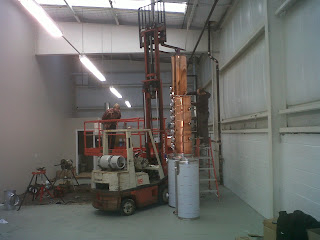
Much has happened at the distillery since our last update. For starters, our still arrived from Germany. It took some expert maneuvering on the forklift by Wilbur (he’s a ninja on the Nissan) to get everything offloaded, and I almost lost a finger in the process. O.k., that’s not true, but I was a great cheerleader. Once everything was in the building, air-support arrived from Koethe Distilling. Over the course of three days, with the help of our German 'Meister Destillierapparat,' we assembled the disparate parts into one glorious, copper monstrosity. It is truly a stunning piece of engineering.

In other news, we received our final building permit, which was not a given and led to many, many sleepless nights. And now, we are in the process of finishing the space buildout (i.e., electrical, plumbing, etc.) The building itself is located in the New Market District of Boston, which is essentially the part of town that serves as “back of house” for the city – full of warehouses and small manufacturers like ourselves. Our space is about the size of one indoor tennis court. When finished, it should feel equal parts distillery, tasting room, and art exhibition space. Enjoy the pictures below.



Sunday, November 28, 2010

T-Shirts, T-Shirts!

Available just in time for the holidays - the first edition Bully Boy t-shirt!

Keeping things close to home (just like our spirits) we chose the American Apparel tri-blend track shirt in Athletic Blue. Available in Men's/Unisex M, L and XL and Women's S, M and L. Get yours before they're gone!

A steal at $10.

To place an order use the PayPal link below (where you can pay w/ PayPal or CC) and be sure to include your mailing address:
Sizes

Friday, November 12, 2010

Presenting our logo and labels


It is with much ado that we present our logo and the finished design work for our packaging! This has been a while in the making and below are labels for our first three products: white rum, vodka and white whiskey (an aged whiskey and aged rum will follow.)


To give you a ‘taste‘ of what’s to come our vodka and whiskey will be made using organic winter red wheat from Aurora Mills Farm in Northern Maine. Using this wheat as our base creates vodka with a subtle sweetness and a whiskey that is clean and mellow. Our vodka will be carbon filtered to remove impurities that create harshness, and our whiskey will be aged in American Oak.


We’re also excited to continue Boston’s legacy as the center of rum production dating back to Colonial days. Our rum will be made with blackstrap molasses from New Orleans. Using techniques handed down from Cognac distillers, we’ll use a blend of cuts to create a sippable rum with depth and a remarkably smooth finish. Our dark rum will be aged in red wine casks giving it complexity without overwhelming it the way used whiskey barrels can.


Our still has arrived from Germany and is in the process of being installed. Look for another blog update with a full progress report soon.